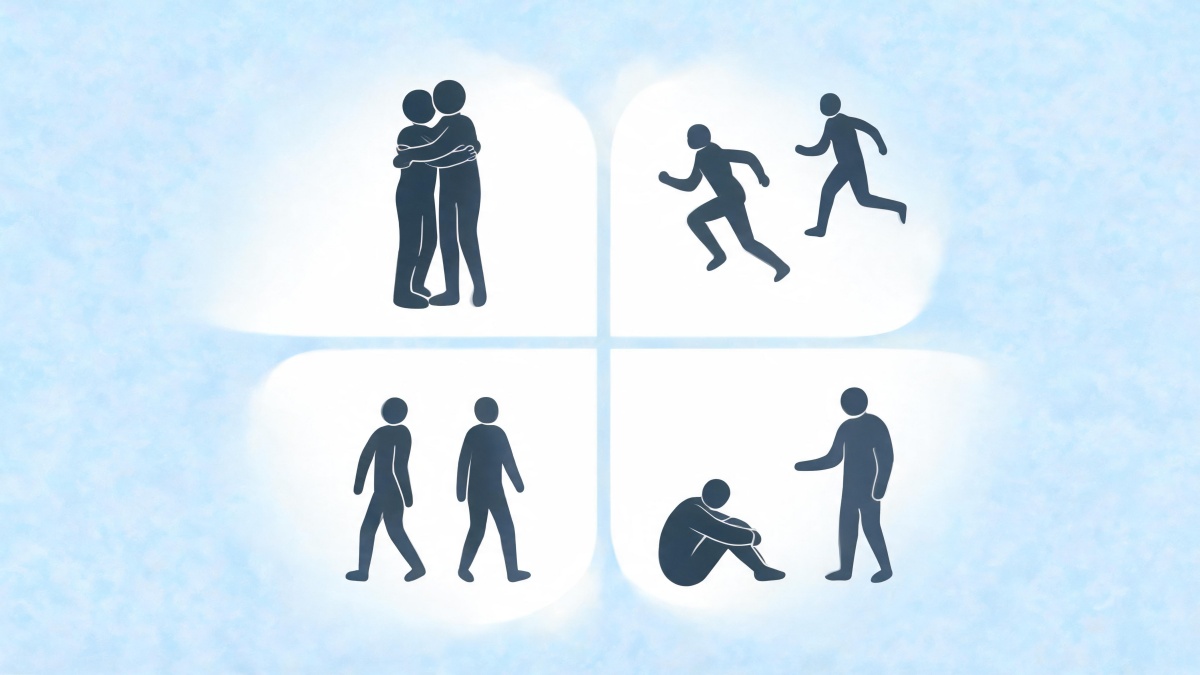
Your attachment style is not a personality quirk. It is a deeply wired relational strategy — built in the first years of your life, refined through every significant relationship since, and running quietly in the background of every connection you make. It shapes how you fall in love, how you fight, how you pull away, how you pursue, and what you tell yourself when a relationship gets hard.
Writers and researchers use attachment ideas to discuss closeness and independence in relationships. This page uses original everyday prompts inspired by those general topics; it is not a validated attachment instrument and cannot assign a clinical classification.
The four styles are organized along two axes: Model of Self (how positively or negatively you view yourself as worthy of love) and Model of Others (how trustworthy and available you believe others to be).
🌿
Securely Attached
You love openly, trust genuinely, and bring steadiness to every relationship you enter.
About 50–55% of adults
🌊
Anxious-Preoccupied
You love deeply and intensely — but the fear of losing love can become its own kind of trap.
About 19–20% of adults
🏔️
Dismissive-Avoidant
You built yourself a fortress of self-sufficiency — and it has kept you safe and kept love out.
About 23–25% of adults
🌪️
Fearful-Avoidant (Disorganized)
You want love more than anything — and fear it more than anything. Both are true at once.
About 5–7% of adults
How to Answer
Rate each statement based on how true it is for you in close romantic relationships — or, if you're not currently in one, based on how you typically are in relationships. Choose what's actually true, not what you wish were true. This assessment only works if you're honest.
Scale: 1 = Strongly Disagree · 2 = Disagree · 3 = Neutral · 4 = Agree · 5 = Strongly Agree
Taking this with your partner?
Have them take it too, then compare results. Understanding both attachment styles is one of the most powerful things a couple can do. Share the link after you finish.